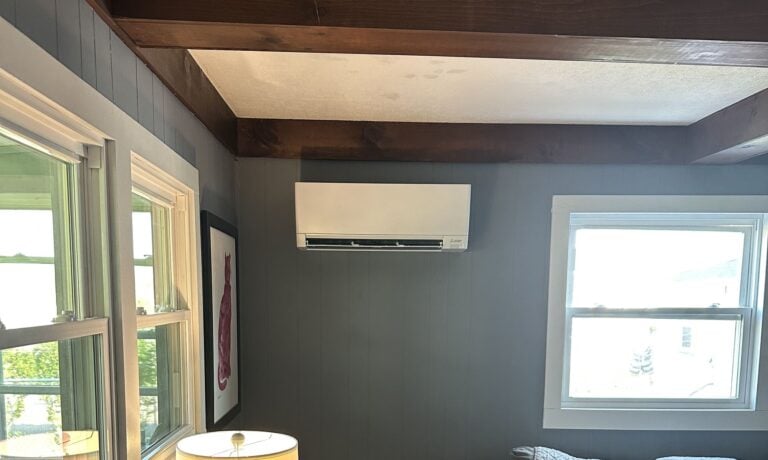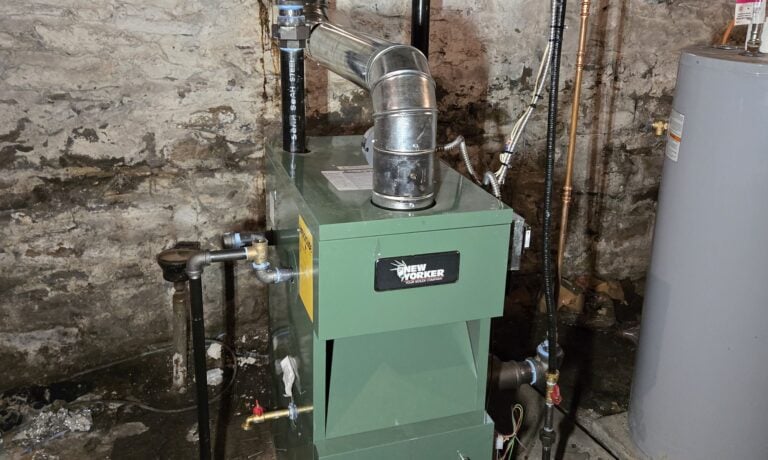



Your mini-split made that upstairs bedroom livable year-round. Now one indoor unit is blowing weakly, won’t start, or runs without making the room comfortable.
The hard part is deciding what to do next. One failed part doesn’t mean the whole system needs replacing. A warranty doesn’t mean every repair is free, either. Age, condition, the failure itself, and the warranty terms all shape the answer.
What Should You Check Before You Call?
A few quick checks can save you a service visit:
- The remote: Make sure it’s set to the right mode, heat or cool, and has fresh batteries.
- The breaker and outdoor switch: A tripped breaker or a switched-off disconnect shuts the system down.
- The filters: Lift the indoor unit’s front panel. Clogged filters choke the airflow.
- A blinking light: Note the color and the number of blinks. That error code helps the technician find the problem faster.
- Winter defrost: If the indoor unit stops blowing for a few minutes on a cold, damp morning, it’s likely defrosting. That’s normal, and it restarts on its own.
- Snow around the outdoor unit: Drifts, common in the Back Mountain, can bury the unit and block its airflow. Clear snow away gently, and never chip at ice on the coil.
What Could Be Wrong With Your Ductless Mini-Split?
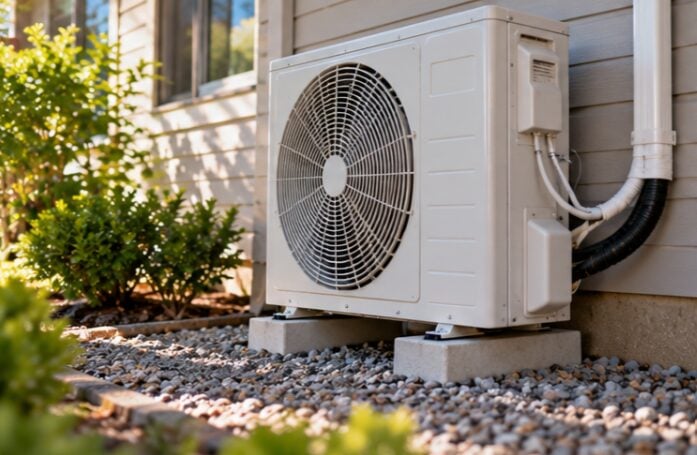
A mini-split problem can start in the indoor unit, the outdoor unit, the refrigerant lines, the controls, or the wiring. The symptom is a clue, but it isn’t a diagnosis. Before anyone talks repair or replace, a technician has to find what actually stopped the system.
Common symptoms include:
- No power: The system may have an electrical, disconnect, breaker, control, or communication issue.
- Weak airflow: A dirty filter, a dirty blower wheel, a blocked coil, or a fan problem may be involved.
- Not heating: Refrigerant, controls, reversing valve, outdoor-unit, or sensor problems are possible.
- Not cooling: The system may have an airflow, refrigerant, electrical, or compressor-related problem.
- Water leaking indoors: A clogged drain line, a failed condensate pump, or an install problem can send water down the wall.
- Ice on the system: Poor airflow or a refrigerant problem can freeze the coil. Turn the unit off, call for service, and don’t chip the ice away.
- Unusual noises: Fans, motors, bearings, mounting components, or other mechanical parts may require inspection.
Don’t guess the part from the symptom alone. A mini-split that won’t cool could have half a dozen causes. A proper diagnosis finds the failure first, then gives you a real repair price to weigh against replacement.
When Does Repair Make More Sense Than Replacement?
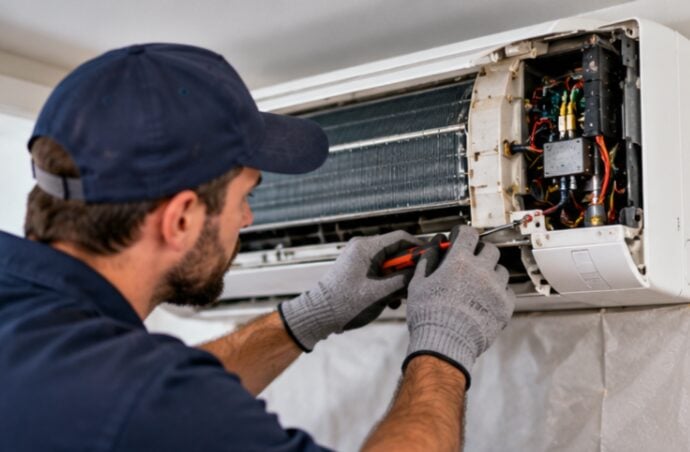
Repair is usually worth it when the mini-split is fairly young and has run reliably. It also helps when the failed part can be swapped without starting a chain of bigger repairs. Look at both the repair and the shape of everything around that part.
| Situation | Repair or Replace? |
|---|---|
| Dirty filter or routine maintenance issue | Repair/service |
| Failed sensor or control component | Usually repair |
| Fan motor failure on an otherwise healthy system | Often repair |
| Refrigerant leak | Diagnose and repair if practical |
| Repeated major failures | Compare replacement |
| Obsolete or difficult-to-source parts | Replacement may make sense |
| Major compressor failure on an older system | Compare total repair cost with replacement |
A repair gets harder to justify when the system has stacked up several expensive problems. Paying for one more part may only delay the bigger decision. A technician should explain what failed and whether other parts look worn before recommending a new system.
If the system has been reliable and the failure is isolated, repair saves a lot of good equipment. Ask what caused the failure and whether the repair carries a parts or labor warranty. Also ask if anything else should be handled while the technician is there.
Most ductless mini-split repairs run about $150 to $650. An inverter board or compressor can run $1,000 to $2,500. Your written quote sets the exact number.
What Does a Ductless Mini-Split Warranty Usually Cover?
A warranty can cut the cost of some failures, but it won’t cover every service call. Coverage depends on the brand, model, registration, warranty length, install requirements, and the part that failed.
Manufacturer Parts Coverage
Most ductless brands offer a limited parts warranty, and the length varies by brand and product line. Mitsubishi, for example, offers up to 12 years on parts and the compressor. That longest term applies when a Diamond Contractor installs the system and it’s registered. Check your own paperwork for exact terms.
Compressor Coverage
Compressors often carry their own warranty terms, because they’re the priciest part of a ductless system. A compressor warranty still doesn’t make the whole repair free. Labor, refrigerant, and diagnosis may not be included.
Labor Is Different
The maker’s parts warranty and the contractor’s labor warranty are separate. Even when a part is covered, you may still pay for labor or diagnosis. That changes only if your install agreement or a labor warranty covers it.
Registration Can Matter
Some brands require registration within a set time to get the full warranty. Keep your model and serial numbers, install paperwork, registration confirmation, and invoices in one place.
Installation Can Affect Coverage
Brands set install and maintenance rules that affect warranty coverage. A poor install, unapproved changes, or skipped maintenance can get a claim denied.
That’s why “it’s under warranty” doesn’t tell you the full cost. Before approving work, ask what the maker covers and what the contractor charges. Ask whether diagnosis, refrigerant, shipping, or labor stays on your bill.
What Should You Check Before Replacing the Mini-Split?
Replacement makes sense when more repairs stop adding up. Just don’t decide from one big estimate alone. Weigh age, efficiency, reliability, parts, and how well it was installed, all together.
Before choosing replacement, ask:
- What exactly failed, and has it needed several repairs lately?
- Are parts still easy to get for this model?
- Would a new system fix comfort problems the old one never solved?
A new system is also a chance to fix problems from the original install. Unit placement, line routing, drainage, wiring, and sizing all deserve a fresh look. Don’t just swap in the same size.
If replacement wins, pick a contractor who explains the full scope of ductless mini-split installation. That covers equipment, unit placement, outdoor requirements, controls, drainage, startup testing, and warranty registration.
How Can You Protect Your Mini-Split Warranty?
Good records make a warranty claim much easier. Most people remember the brand and roughly when it went in. Few can find the model number, invoice, or registration when something breaks. Keep it all together, and service goes faster.
Keep these records available:
- Equipment model and serial numbers
- Original installation invoice
- Manufacturer warranty information
- Warranty registration confirmation
- Repair and maintenance invoices
- Technician diagnostic reports
- Replacement-part documentation
- Contractor labor warranty information
Regular maintenance catches problems before they turn expensive. Filters, coils, drains, wiring, and fans all need attention on the maker’s schedule. Humid valley summers make clean drains and coils especially important.
If your mini-split acts up, don’t keep resetting it or try any refrigerant work yourself. Professional ductless mini-split repair service can tell you whether it’s a warranty claim, a normal repair, or time to replace.
How Do You Decide: Repair, Warranty Claim or Replacement?

The best decision puts the diagnosis, warranty, repair cost, and equipment condition together. A warranty claim can cut the cost of a covered part. A repair suits a healthy system. Replacement fits when major failures keep piling up.
| Consideration | Repair | Warranty Claim | Replacement |
|---|---|---|---|
| System age | Relatively newer or reliable | Any qualifying age | Older or declining |
| Failure | Isolated component | Covered component | Major or repeated failures |
| Cost | Reasonable repair | Covered according to terms | Higher upfront investment |
| Reliability | Generally good | Depends on repair | New equipment |
| Parts availability | Available | Manufacturer-dependent | New parts/support |
| Installation condition | Sound | Depends on warranty terms | Opportunity to correct issues |
Don’t decide on the repair price alone. A $1,000 repair can make sense on a dependable system with years left. The same repair is hard to justify on a unit that’s already needed several major fixes.
A good technician will explain what can be repaired, what the warranty covers, and what replacement involves. Then you’re choosing from real options, not one scary number.
FAQs
Does a ductless mini-split need to be replaced if the compressor fails?
A failed compressor doesn’t always mean a new mini-split. The compressor can often be replaced, especially if it’s still under warranty. The call depends on the system’s age, the total repair cost, and the shape of the other parts. On an older system out of warranty, replacement often wins.
Why does my mini-split smell musty?
A musty smell from a mini-split usually means mold or mildew on the blower wheel or coil inside the indoor unit. Moisture from cooling season gives it a place to grow. Cleaning the filters helps, but the blower wheel needs a professional deep clean. Regular maintenance keeps the smell from coming back.
How do I know if my mini-split has a refrigerant leak?
Signs of a mini-split refrigerant leak include weak heating or cooling, ice on the lines, and needing refrigerant more than once. Those signs can have other causes, too. A qualified technician should find and fix the leak, not just add refrigerant and leave.
Is it worth repairing an older ductless mini-split?
An older ductless mini-split is often worth repairing if it’s been reliable and the problem is one isolated part. Replacement makes more sense when major parts keep failing, repairs come often, or parts are hard to find. It also makes sense when the system never kept you comfortable.
Should I replace all my indoor units if one stops working?
You usually don’t need to replace every indoor unit when one stops working. On a multi-zone system, one indoor unit can often be repaired or replaced on its own. The new unit has to work with your outdoor unit, so confirm that first.
Mini-Split Acting Up? KO HVAC Knows Ductless Inside Out
Ductless is our specialty, and a broken mini-split doesn’t automatically mean a new one. Every ductless mini-split repair service visit starts with a $99 diagnostic. We find what failed, show you, and give you a flat-rate price before any work begins.
As a Mitsubishi Electric Elite Diamond Contractor, we know the warranty side as well as the repair side. If replacement is the better path, we’ll plan your ductless mini-split installation around your layout and comfort needs.
Mini-split blinking, dripping, or blowing weak? Give us a call or book online. You’ll know what failed, what your warranty covers, and what each option costs before you decide.